Just a brief sayso here - my many ideas for posts to Culinary Heritage are on ice due to severe time constraints - to draw attention to this wonderful story. There is so much to say about bananas; Nicola Twilley's illustrated story is a fantastic portrait, touching on chemistry, culinary history, geopolitics and more while keeping a focus on a man whose life's work involves bananas. Here it is: http://www.ediblegeography.com/spaces-of-banana-control/
I remember as a very small child my mom singing the Chiquita Banana Radio jingle. And it could be a trick of memory, or declining sensory abilities, but I recall that bananas used to taste and smell better, and had thinner skins. Does not seem possible I ate Gros Michel bananas in the early sixties, but maybe; more likely the Cavendish variety came from a different country and/or soil. Still, they're great and have remarkable nutritional, baking, and physical properties. I'd long been aware of the heat generated by boxes of bananas at work, but had not realized that this energy was of subject of interest of HVAC engineers (they are also more radioactive than other fruits)!
I plan to enjoy more from the Edible Geography Blog, loaded as it is with great writing about food and hope this recommendation is appreciated.
Rachel

Saturday


Thursday
Take part in your culinary heritage: cook.
Humans are hardwired to learn cooking. The nature, variety and origin of food calls us to find, grow, care for, cook, and eat it - to play with, paint, write, and sing of it.
As with music and language, genetic (nature) and practical (nurture) matters contribute to our capacity for, response to, and practice of our culinary heritage. The ease with which people eat evermore readymade foods - more or less on demand -subverts cooking instincts: using our own hands and abilities while engaged as cooks.
The risk of this ease is devalued connections with food; we risk losing touch with food literacy, our health, and cooking altogether. This loss obscures the evolution and immense complexities of food and cooking in art, tradition, science, and literature. It imposes on us distance from habitats and farms, flora and fauna, and leaves a vast unmet need to touch, taste and see, explore processes, nurture, create, and share. Leaving almost entirely to others what we might do ourselves, we lose worlds of sensation, learning and experience.
In fact, each small choice we make about food is literally a vote for or against the success of what we are preparing, our health and that of our children, habitat destruction in our own areas and the other side of the earth, small family farms, and, ultimately, for or against justice and world peace itself. My Culinary Heritage pages attempt to focus on small choices, encourage readers to make better ones as much as they possibly can, when they can, and to emphasize the surprisingly amazing power of small decisions.
In all of my work, between now at Harvard or my first cooking job - after school thirty eight years ago - food has inspired my profound respect. Any skills acquired have been nurtured by this respect. It frames my work, informs the instruction I provide in class or on the job, is a key element of my other services to individuals and businesses, and moves my hands wether I am peeling onions, modeling knife skills, or creating wedding cakes.
My cooking classes are hands-on and fun; I facilitate interest, curiosity, and creativity. I'm intensely interested in food's history - the story of the olive, grain of wheat, and apple pie; and in it's qualities - the flavors, colors, shapes, textures, chemistry; and in foods' vast interconnections - that a peach may travel so far after months of in the orchard, rains, hanging on the tree by day and by night, and involve so many lives: the grower, picker, trucker, box maker, merchant, insects...; and most of all I am interested in the strong associations food holds for us, as in how certain food means: home.
Please contact me to plan a class or other event, or find out more about my services for your corporate, small business, and individual situations. Remember to "vote"; and let those cook now who have never cooked, and those who have always cooked, cook more.
Rachel

Tuesday
Finally, I got a reply to my email to my favorite canned tomato company! I love their glass jars of strained tomatoes the most. At the time I wrote, their cans were not marked BPA free. Now they are. Time to celebrate by buying lots of them, making pizza, lasagna, and more. Supporting products that are created with concern for the health of consumers makes good sense.
"Let those love now who never loved before,
RachelLet those who always lov'd, now love the more."
p.s. As always I have no affiliation with or financial gain when featuring products.
p.p.s. The formula, below, for Bisphenol A (BPA), an estrogenic mimic used in plastics like water bottles, baby bottles, canned food liners, Cuisinart food processor bowls (Hamilton Beach products are BPA free), and many other food and liquid contact materials. It has been banned in Canada and other countries, and has been linked to cancers, obesity, endocrine disruption, learning/neurological impairments, etcetera - basically to be avoided. It is found in #3 and #7 plastics, other types of polycarbonates, straws, baby toys like rubber ducks and teething rings, and so on. Yes, a toxic substance deliberately added to products intended to be chewed and/or in contact with foods and beverages. The human body assimilates this molecule, with tragic results.

Bionaturae canned tomatoes are packed
with a BPA free lining!
Thank you for your interest in bionaturae and the issue surrounding BPA in cans. Beginning with our 2011 harvest, all bionaturae canned tomatoes are packed in cans that have a BPA free lining. All of our cans with BPA free linings are clearly marked, "The lining of this can was produced without BPA."
 Having a can that is made with a BPA free lining is a positive step in the right direction. However, we want to be honest in communicating to our consumers that this does not guarantee a 100% BPA free product due to the possibility of cross-contamination with other lining material that does contain BPA when the tin is manufactured. At this time, we do not know of any dedicated BPA free tin or can manufacturing facilities. We will continue to stay on top of this issue and make every effort to supply you with the safest option available. Having a can that is made with a BPA free lining is a positive step in the right direction. However, we want to be honest in communicating to our consumers that this does not guarantee a 100% BPA free product due to the possibility of cross-contamination with other lining material that does contain BPA when the tin is manufactured. At this time, we do not know of any dedicated BPA free tin or can manufacturing facilities. We will continue to stay on top of this issue and make every effort to supply you with the safest option available.
Using a BPA free liner is a huge step in the right direction, but we just wanted you to be aware of this fact to be completely open and honest about this sensitive matter. That is why we also offer tomatoes packed in glass jars. The lids of our glass jars are also made with a BPA free lining.
Please remember that our tomatoes are all grown on our farm and they are packed fresh and are never stored in plastic or repacked. Our Italian tomatoes are naturally sweet, and we do not use anything outside of what is declared on each label. Our tomatoes are free of salt, basil and citric acid. Tomatoes are the only ingredient!
We believe this is a very important issue and we will continue to strive to provide the safest, healthiest products possible.
Thank you,
|


Friday
My seventeen months as a confectioner
In the seventeen months between October 1978 and May of 1980, I toiled in the confectionery kitchen between Winter Street and Temple Place (opposite Park Street Station) of Baileys of Boston, Ice Cream and Confections. The main store of the seven Boston area retail stores - which included a greeting cards department in addition to an old fashioned ice cream shop and candy counter - was upstairs, the main office above that.
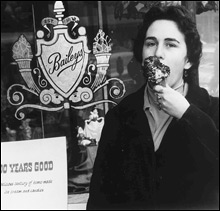 The singular character who taught me the art was John Lewis. John was a remarkable person at the very least due to his age when I met him - 64 - and the fact that he was still working on after I left, and with abundant energy. He used to say, paraphrasing Douglas MacArthur, "Old candy makers never die, they just melt away.".
 He taught me to make fudge, which I produced for all seven stores in about 10 varieties: Butterscotch, Milk, Dark, Two-Tone, Maple Pecan, Marshmallow, Vanilla, Vanilla Walnut, Chocolate Walnut, Rocky Road, and Peanut Butter. I will have to check my memory on this as I may be mistaken. Fudge was a big seller and this kept me busy. But he also taught me to make candy canes, horehound drops, lemon drops, molasses kisses, peppermint, eucalyptus and spearmint drops, and I dimly recall root beer barrels and perhaps a cherry hard candy. The process was to boil up mostly cane sugar and water, with enough invert sugar (C12H22O11) to forestall recrystallization, to about 300 degrees Fahrenheit. We usually cooked up about 25 pound batches. When judged ready by the master, I took hold of one handle of the huge copper pot on the forced air stove, he took the other, and with meaningful eye contact he guided the process of pouring the molten sugar onto the table. Hot candy burns are quite serious, nearly always 3rd degree, so this was akin to the risk of neck breaking when the ballerina is hoisted high in Swan Lake.
The table was remarkable in that it was solid steel, almost 1/2 inch thick, and was equipped below with an intricate system of water pipes, through which very hot steam and very cold water could be piped in order to control the plasticity of the batch of candy. Large iron bars of one and a half inch square and of various useful lengths were placed on the table aforehand to contain the pour.The pour was made with us both tilting the kettle from opposite side of the table. One of us would scrape out the candy that had cooled and wanted to remain using a wonderfully flexible stainless spatula with a rosewood handle. I then immediately took the pot by both handles after the pour to set it on a barrel without a top used only for support at times like this. Master Lewis then added freehand the color pastes and flavor extracts needed to create the product we we needed to restore to proper stock levels. Eucalyptus was a killer since it filled the entire kitchen with an intense, palpable, scent that came close to knocking me out. Lemon and peppermint were not far behind.
My favorite was horehound, which was flavored in the pot with a tea Master Lewis brewed from whole horehound stem and leaf. But almost all followed the same routine after pouring:he would fold the candy with a spatula or sometimes his bare hand grasping the cooler edges (and I think he was showing off there), toss on the extracts and colors, which was quite a psychedelic experience since not only did it involve scent but melting bubbling blurry colors as it was worked to a uniform state, and finally become a saggy sort of mass that he would carry like a baby to the canvas covered table. This other table featured a heated bar of metal that radiated heat towards the mass of candy to keep it workable. The Master moved the candy with cotton gloved hands closer or further from the heat as needed while he worked like a chiropractor to pull the mass into a more slender cylinder of roughly 2 inches diameter.
 This constantly formed cylinder of hot candy was then fed into the hand cranked machine - which I had the honor of cranking - to produce uniform drops or barrels of hard candy. The machine rollers were interchangeable to create various shapes and I had to rotate the crank at EXACTLY the right speed per the Master's directions. The candy came out the other side in stable form, thanks to the brass and atmosphere absorbing the heat, and it collected into a large pile we tossed with extra fine sugar and which we then attacked with a special scoop that would place the candy into cellophane bags on a very ancient and accurate scale. The bags were stood upright as filled and when finished I was tasked with stapling them shut with paper labels specific to each candy.
 Candy canes, including the very large ones to be held by Santa for window displays, followed a similar process, except that half the mass of candy went right from the iron table to the hook hung on the back of a door. It was a large hook, such as for catching Jaws but not as sharp. The master always did this part himself and I will never forget the sight of him heaving the large mass of semi molten hard candy onto the hook and catching it as it oozed down each side in order to flip it over the hook again, putting gravity to work very neatly. As he continued, the candy became whiter and whiter as it filled with air bubbles. Meanwhile I was to splash pure oil of peppermint onto the candy as he directed. Thus the flavor was folded in and the white part of the candy cane made. He then joined the two and twisted them into many canes in a short time.
The chocolate making we participated in is another amazing aspect of the work. We used an interesting machine that made fondant after we poured in the correctly cooked mixture of sugar and invert sugar. It was something like a cement mixer but instead of a barrel is was an open pan about six feet in diameter with the revolving machinery that scraped the pan in the center. It was massive. Fondant formed the basis of many - but not all! - of the chocolate covered candies - milk, dark, and white - that we produced. In order to make these, for example peppermint cream centers, the Master would melt a certain amount of fondant and flavor it. He would then keep it warm while he filled up his large funnel with the mixture. He stopped the candy from escaping by using a stick about the size of a drumstick. But not stopped enough to prevent some drips of fondant to fall upon his shoes - which made him appear as one who feeds pigeons too intimately. He walked into the starch room and allowed just the right amount for individual candies to escape from the funnel and fill the molds that had been previously prepared. Each mold held perhaps 75 candies. He bent over in concentration and raised the stick up repeatedly as he moved the tip of the funnel into position and released the candy into the mold, making a thwup, thwup, thwup sound.
The molds were created as follows: about a hundred pine trays designed to accommodate fingers as they were stacked and to allow about two inches of corn starch were stored in the starch room. I was to fluff up the starch, scoop it into the trays, level the trays with a yardstick, and stack them. The master then would choose from the hanging molds and press the molds into the starch to create the shape of the candy. He would stack up as many as he needed, fill them, and re-stack them to cool. It would then fall to me to dump them into a frame with screen at the bottom, shake them a bit, and place them on trays. These would be brought in to the ladies for hand dipping in the cool room or else given to the person who placed them on the enrobing machine for machine dipping. Things like chocolate covered cherries, peanuts, and raisins had
to be hand dipped. John Lewis said more than once that whoever could invent a way to machine dip raisin and peanut clusters would be a millionaire.
The enrobing machine depended upon a source of tempered chocolate, and it was my responsibility to see to the machines for tempering being filled up. We had three that heated and conched the chocolate to keep it ready for dipping - very close to body temperature. The ladies who did the hand dipping and whose work was truly an art form of handling chocolate and designing identifying marks upon the tops with liquid chocolate also drew from the tempered chocolate reservoirs as they needed. They used a bare hand (probably softer than the Queen Mother's) that seemed to have a mind of its own they carried on conversation throughout the day and used the other hand to perform other tasks.
There was so much more - making nougats, caramels, various chocolate barks, the boxing of the chocolates, the caramel covered popcorn, the rush of holiday orders, the elementary school tours that came through, the rather solitary man, Peter, who made marshmallow and hot fudge topping almost all day long in his little room to supply the ice cream counters.... There are still some places, like Putnam Pantry in Danvers and Harbor Candy in Ogunquit , that hove to the traditional manner of confectionery. But it is a dying art, as most candy is being made by large soulless factories in multi ton batches. As a pastry chef, I still use what I learned at Baileys when I make seasonal candies or chocolates for for loved ones, wedding cakes, and other desserts. Spun sugar, caramel sauce, and my skills as a chocolatier will always find an application - until I melt away I suppose.
Spanish chef Ramon Morato was at Harvard's Cooking and Science public lecture series this past week demonstrating a few properties of chocolate for a large audience. He has written a book called Chocolate you can browse through on the web and it seems rather complete as to the history, cultivation, and technology of chocolate. You can see photos of enrobing machinery with explanation of techniques - all more or less identical to those I engaged in at Bailey's.
Spanish chef Ramon Morato was at Harvard's Cooking and Science public lecture series this past week demonstrating a few properties of chocolate for a large audience. He has written a book called Chocolate you can browse through on the web and it seems rather complete as to the history, cultivation, and technology of chocolate. You can see photos of enrobing machinery with explanation of techniques - all more or less identical to those I engaged in at Bailey's.
For an interesting history of sugar, let me recommend Sweetness and Power, by Sidney Mintz. But for living history, I am afraid I know of no place like Baileys. There was a store in Harvard Square which is one of many lost treasures of The Square. Candy and ice cream, like tobacco, became just too laden with catastrophic medical outcomes in people's minds, and ceased to be enough to sustain a store under one roof. Though of course we all know how to get our hands on both candy and ice cream now.
Rachel
Sunday
Vanilla Heaven
I recently had the pleasure to receive notice from Mr. Agas Ramada Setiadi about what looks like vanilla heaven: his organic vanilla plantation in Java. His web site is truly wonderful - but see below for ordering in USA-showing his healthy looking farm, organized and clean facilities, beautifully photographed products and processing steps, and historical, botanic, and culinary information about vanilla. I can smell vanilla just by visiting his site and am very excited to try his product, which I just ordered. Best of all it is FAIR TRADE! My favorite lines from his site are these: "Vanilla is the underwear of the baking world; it makes everything look good and plays well in the sandbox with others." since I would never have connected underwear with vanilla. But this makes sense, because I can add vanilla to - for example - cut strawberries with a bit of
sugar and the aroma of the berries and that of the vanilla do some behind the scenes magic.
I have received the Vanilla in the mail and can report that it rises to the level of being an elegant gift for a birthday or other event, besides being in the class of highest quality ingredients that I use for my cakes. The service is also impeccable. Very important to note that one must order it from Indri Vanilla, run by Chef Whitney Olsen of Tempe Arizona, if you are shipping inside the U.S.A.
sugar and the aroma of the berries and that of the vanilla do some behind the scenes magic.
I have received the Vanilla in the mail and can report that it rises to the level of being an elegant gift for a birthday or other event, besides being in the class of highest quality ingredients that I use for my cakes. The service is also impeccable. Very important to note that one must order it from Indri Vanilla, run by Chef Whitney Olsen of Tempe Arizona, if you are shipping inside the U.S.A.
Agas even has instructions for producing an extract using apple cider rather than alcohol, to conform with Muslim dietary practices. Plus, he has links to a YouTube video showing vanilla orchids being hand pollinated, recipes and tips- such as how to make your own vanilla coffee, and most important: how to HOW GO TO BANDUNG via Air Asia and driving instructions to his planation. I have an urge to buy a lottery ticket at this moment. Sigh.

For now I will be content with the small piece of heaven represented by his vanilla shipped to me.
I descend from bakers via both parents so perhaps this accounts for what some see as my fanatical enthusiasm for vanilla (and cacao, and butter, yeast breads rising...). But no matter, I am so glad to share devotional interest in this vine with so many people, past and present. The Totonac people, of Mazatlan Valley on the Gulf Coast of Mexico first cultivated vanilla for medicinal use. According to Totonac mythology, the tropical orchid was born when Princess Xanat, forbidden by her father from marrying a mortal man, fled to the forest with her lover. The lovers were captured and beheaded. Vanilla vines grew on the spot their blood touched the ground. Conquered by the Aztecs- who apparently began culinary use of vanilla, the Totonacs paid tribute by sending vanilla beans to the Aztec capital, Tenochtitlan. Xanat translates roughly as nectar of the gods, and the twisting vines evocative of an embrace, perhaps. It seems completely unsurprising that a passionate and divine origin is ascribed to vanilla.
In his book, Vanilla Orchids: Natural History and Cultivation, Ken Cameron provides more botanical history, molecular analysis, and instructions for producing vanilla at home. Vanilla vines under cultivation must be checked each day for flowers in order to hand pollinate each one - since only in certain small areas of Mexico does a specific species of bee exist with a natural ability to pollinate the orchid and create the fruit. The drying and other handling of vanilla is likewise an exacting labor of love - making the high price understandable.
Rachel

Saturday
Eel migration and Hurricane Irene
I love storms, rain. It's difficult to relate with negative comments about stormy weather. Of course, there can be some inconveniences - too much rain in too short a time ruined my tomatoes last year and I empathize with other's more serious losses.
But the excitement of a storm, the smell, watery reflections and varieties of rain, wind, snow, and skies energize me - even if it is only a local passing shower. Hemispheric scale events like Hurricane Irene, now approaching New England, do more to promote contemplation of the awesome world from which our mundane affairs distract us.
Irene comes with the new moon, darkest of nights, bringing wetness and flooding eels need to complete a life phase: passing back to its origins in the middle of the Atlantic, far from its sojourn to inland waterways and pools. More sensitive and tuned in to these events, eels right now are on the move.
Having just read Eels, An exploration, from New Zealand to the Sargasso, of the worlds most mysterious fish, by James Prosek, Hurricane Irene takes on an intense shade more meaning. Part ethnology, part natural history, Prosek's book tells us a story not only of this amazing fish but also stories of eels woven through the lives of many cultures - their religions, economies, art and lore. He also points to what has been mostly forgotten in this modern rush of activity in which we are enmeshed, a decline of knowledge that mirrors the decline of the eel. He is also a gifted artist, so reading his book is doubly pleasurable for its illustrations, which reflect the respect with which he approached the native people of New Zealand, other pacific ocean cultures, as well as scientists and others whose lives the eel touches.
I remember fishing when I was young in Wareham, by Buzzards Bay, with my uncle Donald. A sailor, in the navy before WWII, who had the arms and attitudes that made me think of Popeye, he was a demolitions expert tasked with killing Japanese soldiers in the tunnels of Iwo Jima and had seen terrible things. Did this make this tough man more aware of every small magical, delightful detail? Perhaps; his salty stories did touch on wonderful things he'd seen 'round the world on the water. Fish featured big to him. He had built a row boat - it leaked and was as heavily built as a battleship. But we got about the pond by the cottage he and Aunt Peggy kept, catching horn pout, pickerel, bass, and sometimes eels. He encouraged me to eat eels some day, but as Peggy would not clean and cook them, we had to throw them back.
Long years after, I ate eel in a Japanese restaurant. It was like mackerel, but sweeter, darker, and more buttery. I would have eaten eel often if caught myself - since who knows where the restaurants get them? China, most likely, as Prosek describes, mostly for the Japanese market, for which eel has a still vibrant culinary, mythical, and tremendous economic appeal. The Japanese eel has all but been fished out. Heavily funded research of ways to farm them in man made ponds has been under way for years. Now I know eels everywhere are possibly endangered, I am hoping for the success of the scientists involved in this effort, as well as for those working to protect the habitats for which the eel has surprising and profound influence.
Sunday
Dolphin Meat
Yes, the meat is eventually labeled as whale meat from a different, more sought after, species and purchased at supermarkets, high levels of mercury notwithstanding. The animals are slaughtered in a brutal manner, at a rate of about twenty thousand individuals annually. The film, The Cove, alleges certain facts that seem to be in dispute - such as that dolphins are culled before the slaughter to meet the needs of places like Sea World and dolphin petting sites around the world, supplying them with dolphins for their purposes. Evidence is not immediately apparent and these places deny it. Yet, overall, images captured let the film speaks for itself and are not open to dispute. See the film, visit the site if you love dolphins free in the seas.
One comment in the film by one of the Japanese fishermen was a rationale to the effect that while in the west we eat cattle, here they eat whales, dolphins, and other creatures. A great observation, when divorced of its intent to justify the practice, since in both the west and the east it seems that socio-culinary traditions have spiraled out of control and certain acts are referred to as if historically based by those who practice what is in fact very far removed from tradition.
Rachel


One comment in the film by one of the Japanese fishermen was a rationale to the effect that while in the west we eat cattle, here they eat whales, dolphins, and other creatures. A great observation, when divorced of its intent to justify the practice, since in both the west and the east it seems that socio-culinary traditions have spiraled out of control and certain acts are referred to as if historically based by those who practice what is in fact very far removed from tradition.
Rachel

Monday
Adopt a rainforest
The enthusiasm of my friend Korbin Duley at Cuipo.org prompts me to post once again after long quiescence here at Culinary Heritage. After years of seeing signs along highways proclaiming that some fast food joint "adopted" a highway I have issues with this use of the word, adopt, even though I am glad that the process contributes to cleanup. Something temporary and too commercial about it, and I have suspected that the stretch of road could be un-adopted at will and then perhaps re-adopted by some other commercial entity - oh wait, corporations are persons now, I forgot - I mean, person.
Here is something permanent: adopt a square meter of rainforest for five dollars. Or more! Look it up on google maps and show your kids, friends, coworkers, and employer- who may make a matching gift. It will make a permanent difference to the ecology of the earth and the five dollars will come back to you in so many good ways. Along with adoption, you merely pledge to protect this parcel of land by acting with care regarding the things you do every day. You can make up your own pledge or follow something like this:
I will buy organic foods grown using sustainable farming.
I will carpool to work with friends 2 days per week
 I will recycle my newspapers
I will use reusable grocery bags instead of paper and plastic
I will recycle plastic
I will buy locally grown vegetables to reduce my carbon footprint


Here is something permanent: adopt a square meter of rainforest for five dollars. Or more! Look it up on google maps and show your kids, friends, coworkers, and employer- who may make a matching gift. It will make a permanent difference to the ecology of the earth and the five dollars will come back to you in so many good ways. Along with adoption, you merely pledge to protect this parcel of land by acting with care regarding the things you do every day. You can make up your own pledge or follow something like this:
I will buy organic foods grown using sustainable farming.
I will carpool to work with friends 2 days per week
 I will recycle my newspapers
I will use reusable grocery bags instead of paper and plastic
I will recycle plastic
I will buy locally grown vegetables to reduce my carbon footprint
So please, go to the Cuipo.org site, read about it, look at the stunning videos, and maybe next time you see one of those highway signs, you will remember you did something pretty cool. By the way, a Cuipo is a tree, Cavanillesia platanifolia, that is extremely large and grows in such places as Panama, and depicted in this photograph and this beautiful painting by Ricardo Sanchez Beitia. See his other work at http://fineartamerica.com/profiles/ricardo-sanchez-beitia.html
Sunday
Julie and Julia
I finally saw this film, about a year after it came out, and am undecided wether Nora Ephron is riffing on or sucked in by the vapid celebrity chef aura that surrounds so many cooking related television shows (and best sellers) that involve egos out of control, rude behavior, and poor decision making. Going gaga over celebrities does not appear related to a commitment to the art and science of cooking, to the practice, learning and teaching of it. Julie's quest was to be, not a cook, but a writer - where "writer" is defined not so much by practice, telling a good story, writing what one knows, creativity, and other typical parameters as by being known as a writer. Possibly this is an unfortunate by-product of universities being in the business of "teaching" people how to write - only to have them end up doing it for money themselves, and even teaching it after knocking off a best seller
Anyway, once cooking was settled on as a thing to write about, the quest then narrowed to be recognized by some (any?) food expert or celebrity, and especially Julia Child. Cooking was a means to that end rather than valued intrinsically. The chorus of blog reader's support seemed to cement the popular conceptualization - and without them, Ephron seems to hint, Julie would have hung up her electronic toque. The film's comparison of the lives of Julie and Julia is a rich vein of feminist social commentary that I never seem to be able to tell how or if Ephron intends us to parse in her films. Included is a vignette of Julia's attempting to "do something" by learning hat making before settling on cooking as her true path. Julia sincerely followed a natural progression that relied heavily on her confidence in taking chances and wish to change the world for the better. Perhaps being different in terms of height fostered her openness to be different in other ways. She also had the good sense to marry someone who saw her as an equal. It was Julia's passion for food and cooking along with frustration that French cookbooks were unavailable in English translation that sensitized her to be ready for the opportunity to share what she had found out about French food that eventually came about through Madames Beck and Bertoilles.
By contrast, Julie's choice of following in one year all the recipes of volume one of Mastering the Art of French Cooking and writing about it seemed to have sprung from oddly mixed motivations such as proving untrue her mom's critique that Julie never finished anything, comparing herself to someone she knew who was published, therapeutically buffering herself from the trauma of her call center job, and doing something that would obtain attention. It had the mark of a stunt, like going over Niagara Falls in a barrel. Interestingly, although Julie claims inheritance of Mastering from her mom and cites a memory of her mom cooking something great from it (beef burgundy), 2001 was the year that the 40th anniversary edition of the book hit the streets - a fact that cannot have been lost on real life New Yorker Julie Powell as she cast about for something to write about that might have financial traction.
One of the many details linking writing and cooking as a contrivance came when Julie asked her husband to guess who was coming to dinner. My guess was that it would be her mom, to whom Julie (supposedly) owed part of her success acquiring blog readers by her example of cooking that very beef dish and by putting Mastering into her hands. Instead, it was a famous person she never met who happened to be Julia Child's editor. Having a good name and valuing ones career, wether humble or very elevated, is all fine and good of course, nothing against famous people here. But how embarrassing to fawn over someone just because she is Julia Child's editor! As a friend once colorfully described the silliness of a celebrity: "Does she think she shits ice cream?". I was not surprised that the invitation was declined; rather, it seemed just.
Of the many reviews and comments I have come across for Julie & Julia, the one that most closely agrees with my analysis but is exponentially smoother and more incisive than anything I can write is found here:http://www.troubleandstrife.org/?page_id=263 . I shall offer no more critique and defer to this as I believe it best captures the complexities of the film.
Yet there is an air of recursiveness about Nora Ephron's work that prompts me to look again, to find referential details and wonder about their genesis. Most interesting for me are the comments* (see below) offered by Meryl Streep and Nora Ephron on the Charlie Rose show that indicate that the character of Julia Child in the film was a patchy, significantly skewed construct of Julie's based on her limited understanding of who Julia Child was and what she did. So is this a reflection of Ephron's accurate understanding that her audience will see what they are prepared to see, like Julie, and yet a subversive and artful tactic to draw them to learn more about the real Julia, since of course the film generated widespread interest for people to read Julia's work and view her old shows? The renewed interest in cooking and in Julia Child is at least one unambiguous benefit of the film - another being, I hope, that people who ought not to may stop writing about food and cooking hoping for a similar "success" - or will this just encourage more blogging for bucks? In another facet of this recursiveness Meryl Streep once had an interaction with Julia Child when a younger Streep asked for Child's support for an organic food organization. Julia declined, but it was a mistake she would later work to correct when she realized that organic food was crucial to cooking and health.
As for how the film yin yang's (forgive the use as a verb) with my own life, I had to laugh out loud at the part where Julie fell asleep on the couch because once, when as a teenager I made croissants from Julia's recipe, I had a similar experience. I had begun after lunch the mixing, raising, folding, and resting to get all the laminations needed for a good baked croissant. Of course I had done other things that day but the time I expended to get it right was extensive and it was close to midnight by the time I put the fully proofed and eggwashed crescents - some plain, some with a bit of chocolate or raspberry in the center - in the oven. Just for a few minutes, or so I thought, I lay down on the couch, When I awoke, the fire alarm was blaring and my sisters, mom, and dad were rushing down the stairs in terror at the noisette smoke filling the house. I leapt to my feet, rushed the pans of charcoal croissants out to the back door, and tossed them into the rather deep snow we had at the time. A singular sound emitted from the snow on receiving the overdone, charred laminations - a sound I expect I never again will experience. Later, after being thoroughly and rightfully given what for by my family, as I was cleaning up, I snuck out and broke open some of the croissants - scientific curiosity added to maternal feelings of loss of what I had come to feel were my little children. I ate the centers, which consisted of about a jumbo cashew shaped portion, looked up into the wintery stars, and felt some sort of perverse completion
at the unique and wonderful taste. My mom reminded me recently that this was also the occasion for a bird to enter into the basement due to the back door being propped open.
Also, I work in a kitchen in which Ms. Child once taught, in roughly 1962, as she was working on The French Chef. My informant was a man, an MIT student in the early sixties, who was in a cooking class I was leading back in 2005 . He had been a student in some of these classes, and commented that the pegboard ....

had come about due to the influence of Paul Child. At the time I was astounded by the information, though it makes perfect sense given the Harvard Square location, but I am not a good researcher, else I would have got his full name and address. My excuse is that at the time I was preoccupied with fighting the special education system's bungling of my son's education. If anyone knows more, please tell me.
Finally, I also worked at a call center as a senior agent for Federal Express whose speciality was taking calls from irate customers and those with impossible problems, the solving of whose issues earned me scores of management commendations and appreciative customer letters. Other agents would pass these off to me when faced with a demand to speak to a manager. I did not know a call center would be part of the film and it gave me flashbacks.
*
MERYL STREEP: So it was already kind of caricatured in your head.
And I didn’t want to -- I wanted to look at her in the idealized way that
Julie did. I wanted, because this is Julie’s imagined Julia, in her head
she imagines this gal in Paris with her -- with her husband. And I think
because it’s in this rosy (ph) hue, I just wanted to make it as real as it
could possibly be but I didn’t feel that I really had to adhere to every
piece of research I’d done on Julia. I just wanted to make a human being
that lived.
NORA EPHRON: Well, we don’t know. But in -- you know, there’s no
question that the Julia we show in the movie was Julie Powell’s idea, you
know. And I certainly in reading about her thought oh, I’m not like that.
I’m just not like that. She’s a much better human being than I will ever
be. And I think -- I think you share that --that feeling.
MERYL STREEP: Yes.
CHARLIE ROSE: You have said this before, that Nora gave you kind of
direction that -- when she told you she needed you to embody, you said this
earlier, Julia Powell’s idea of Julia Child.
NORA EPHRON: Yeah. That wasn’t me. That was Meryl’s idea, that was
-- that was one of the ways Meryl .
CHARLIE ROSE: To get on to it.
MERYL STREEP: Yeah, that’s one of the ways that I could climb on and
not feel too guilty about it.
My favorite image of Julia
Subscribe to:
Posts (Atom)